

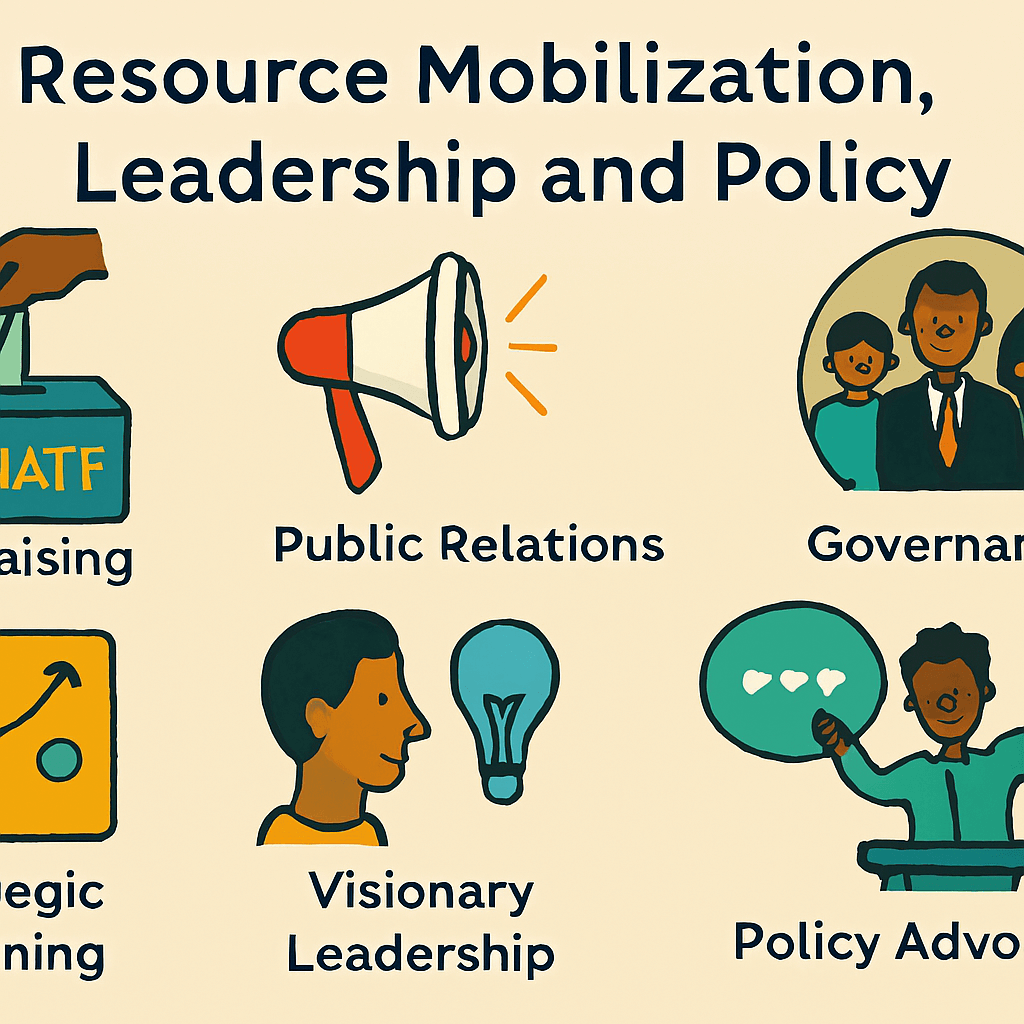
Resource Mobilization, Leadership and Policy

Wishlist Share

About Course

Course Overview

The course on Resource Mobilization, Leadership and Policy is designed to equip participants with the knowledge, skills, and strategies needed to secure, manage, and sustain resources for educational and social development initiatives. It integrates principles of leadership and policy development with practical approaches to resource mobilization, enabling participants to build strong institutions and programs that are financially and strategically sustainable. Through case studies, interactive sessions, and applied practice, learners will gain a comprehensive understanding of how effective leadership and policy frameworks can drive resource mobilization and institutional growth.


Learning Outcomes

By the end of this course, participants will be able to:

  1. Understand the concepts, principles, and practices of resource mobilization in education, NGOs, and public/private institutions.

  2. Develop effective strategies for fundraising, grant writing, partnership building, and donor engagement.

  3. Analyze how leadership styles and approaches influence organizational sustainability and resource mobilization success.

  4. Evaluate the role of policy in shaping opportunities for resource mobilization and institutional development.

  5. Apply leadership and policy frameworks to design and implement resource mobilization plans aligned with institutional goals.

  6. Strengthen advocacy and negotiation skills to influence decision-making and policy processes related to funding and resource allocation.


Target Audience

This course is intended for:

  • School leaders, administrators, and policymakers in the education sector.

  • NGO managers, program coordinators, and project officers.

  • Professionals in government and international development agencies.

  • Researchers and academic staff seeking funding for projects and programs.

  • Emerging leaders in education and development who wish to build practical resource mobilization and policy skills.

Show More

Course Content

Types and Management of Educational Resources
This topic/module component focuses on the different categories of resources that support teaching, learning, and overall educational development. Understanding the types helps educators effectively plan, source, and utilize them to enhance learning outcomes.

  • Human Resources
  • Time Resources
  • Physical Resources
  • Financial Resources
  • Community Resources
  • Digital Resources

Human Resource Development
Human Resource Development (HRD) refers to the systematic process of improving the skills, knowledge, abilities, and overall potential of people within an organization to enhance both individual and organizational performance. It involves activities such as training and development, career planning, mentoring, performance management, and organizational learning. In the education sector, for example, HRD ensures that teachers, administrators, and support staff continuously upgrade their competencies to meet evolving curriculum demands and student needs. Ultimately, HRD focuses on empowering individuals, fostering innovation, and creating a culture of continuous growth that drives long-term success.

Procurement and Management of Teaching and Learning Resources
This module focuses on the strategies, processes, and best practices involved in acquiring, organizing, and utilizing resources necessary for effective teaching and learning. It highlights the importance of ensuring that teaching and learning materials are available, accessible, and appropriate to support the curriculum and enhance student learning outcomes.

Information Communication Technology (ICT) in Education Management
This module explores how ICT supports effective management and improvement of education systems. It highlights the growing role of digital tools in planning, communication, data management, and decision-making within schools and educational institutions. Through this module, learners understand how ICT enhances efficiency, transparency, and collaboration among teachers, administrators, students, and parents. It also covers the use of management information systems (MIS) for record keeping, monitoring performance, and supporting evidence-based policy decisions. The module emphasizes the need for ICT integration in teaching, learning, and administration to promote innovation and global competitiveness. It also discusses challenges such as limited infrastructure, digital literacy gaps, and data security concerns. Overall, it shows that effective use of ICT in education management leads to improved organization, accountability, and quality of education delivery.

Leadership and Resource Management in Education
This module focuses on how educational leaders effectively manage and mobilize resources to achieve institutional goals. It highlights the critical role of leadership in planning, allocating, and monitoring financial, human, and physical resources to support quality teaching and learning. The module also examines strategies for optimizing limited resources, ensuring equity, and aligning resource use with school policies and national educational objectives. By combining strategic leadership with sound resource management, educational leaders can create sustainable, efficient, and inclusive learning environments that improve student outcomes and strengthen the overall education system.

Financial Budgeting in Education
Financial Budgeting in Education, focuses on the principles and practices of planning, allocating, and managing financial resources in educational institutions. It highlights the importance of creating realistic budgets that align with institutional goals, national policies, and the needs of students and staff. The module also covers strategies for monitoring expenditures, ensuring accountability, and making data-driven decisions to optimize the use of limited funds. By understanding financial budgeting, educational leaders can ensure resources are used efficiently, support quality teaching and learning, and sustain long-term institutional development.

The Role of Stakeholders in Budget Management
The module on The Role of Stakeholders in Budget Management explores how different groups within and outside an educational institution influence the budgeting process. The module shows that effective budgeting is not the work of the finance office alone, but a shared responsibility that involves school leaders, teachers, support staff, parents, boards, government agencies, and community partners. It highlights the importance of open communication, transparency, and collaboration in making financial decisions that reflect real needs and priorities. The module also explains how involving stakeholders strengthens accountability, builds trust, and improves the accuracy of budget forecasts, since each group brings unique insights about resource gaps and emerging needs. In addition, it looks at how stakeholder engagement helps institutions mobilize extra resources, manage risks, and ensure that budgets support both long-term goals and daily operations. Overall, the module emphasizes that strong stakeholder participation leads to more realistic, fair, and sustainable budget outcomes.

Accounting Procedures in Education
This module explores the fundamental accounting procedures essential for managing financial operations in educational institutions. It covers key principles of accounting, record-keeping, and financial reporting, emphasizing accuracy, compliance, and ethical practices. Learners will gain practical knowledge on managing receipts, payments, payroll, and procurement, as well as preparing and interpreting financial statements. The module also highlights the importance of internal controls, audits, and accountability in ensuring that institutional funds are used efficiently and transparently. By mastering these procedures, education managers can maintain financial integrity, support informed decision-making, and enhance overall resource management.

Auditing in Educational Institutions
“Auditing in Educational Institutions,” focuses on the systematic review of financial records and processes to ensure accuracy, accountability, and compliance. Auditing helps detect errors, prevent fraud, and verify that funds—such as tuition fees, grants, and donations—are used appropriately. The module covers both internal audits, conducted by the institution’s staff to monitor day-to-day operations, and external audits, carried out by independent auditors to provide an unbiased assessment of financial statements. Through auditing, schools can strengthen internal controls, improve financial reporting, and provide assurance to stakeholders that resources are managed responsibly. Overall, effective auditing promotes transparency, supports sound financial decision-making, and protects the institution from mismanagement or financial misconduct.

Earn a certificate

Add this certificate to your resume to demonstrate your skills & increase your chances of getting noticed.

selected template

Student Ratings & Reviews

No Review Yet
No Review Yet

Want to receive push notifications for all major on-site activities?

Gilbert Mutingu Jaddy

Gilbert Mutingu Jaddy

Founder, Director & Chief Executive Officer

I will be back soon

Gilbert Mutingu Jaddy
Hey! We’ve got a great sale offer running. I am happy to tell you about it. Let me know if you've any questions.
Contact Us Today
chat