
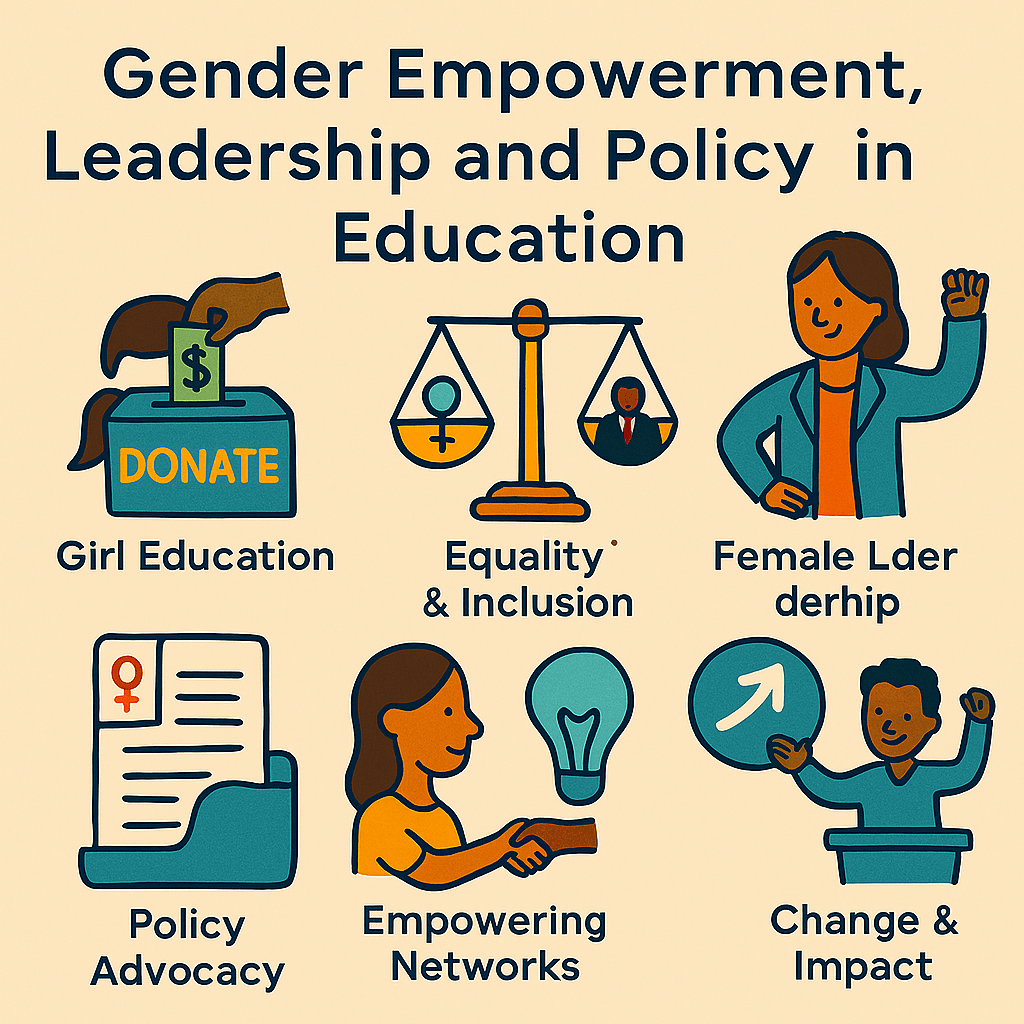
Gender Empowerment, Leadership and Policy in Education

Wishlist Share

About Course

Course Description

This course explores the intersection of gender, leadership, and policy in the field of education. It examines how gender dynamics influence access, participation, and leadership opportunities within educational systems, while also analyzing policies that promote or hinder equity. The course equips participants with knowledge, skills, and strategies to promote gender empowerment in schools and institutions, and to engage in leadership practices that foster inclusivity, equity, and sustainable educational development. Through case studies, debates, and practical projects, participants will critically analyze global and local policies on gender and education, and develop leadership approaches that advance equal opportunities for all learners and educators.


Course Objectives

By the end of the course, participants will be able to:

  1. Understand the concept of gender empowerment in educational contexts.

  2. Analyze the relationship between gender, leadership, and educational policy.

  3. Evaluate policies and practices that address gender equity in education.

  4. Develop leadership strategies that promote inclusivity and empowerment.

  5. Advocate for gender-sensitive policy reforms in education systems.


Course Learning Outcomes

Upon successful completion of the course, learners will:

  1. Demonstrate knowledge of key theories and concepts related to gender empowerment and leadership in education.

  2. Critically analyze educational policies through a gender lens.

  3. Design strategies and interventions to foster gender equity in schools and institutions.

  4. Apply leadership skills to advocate for inclusive and gender-responsive education policies.

  5. Engage in reflective practice on their role as change agents in advancing gender empowerment in education.


Target Audience

  • Educators and school leaders (teachers, principals, administrators).

  • Policy makers and education officers.

  • University and college students in education and social sciences.

  • NGO and community-based organization staff working in education and gender advocacy.

  • Professionals pursuing careers in educational leadership, policy, and gender studies.

Show More

Course Content

Introduction to Gender Empowerment
Gender empowerment refers to the process of increasing the capacity of individuals, especially women and marginalized groups, to make choices and transform those choices into desired actions and outcomes. It emphasizes equal opportunities, access to resources, and participation in decision-making processes across all spheres of life, including education, politics, and the workplace. In education, gender empowerment is critical because it ensures that learners of all genders are provided with the skills, confidence, and opportunities to succeed and lead. By addressing inequalities, challenging stereotypes, and promoting inclusive policies, gender empowerment contributes to creating just, equitable, and progressive societies.

  • Understanding Gender and Empowerment
  • Key Concepts Applied in Gender Empowerment
  • Importance of Gender Empowerment
  • Gender Roles, Stereotypes and Socialization
  • Key Strategies for Promoting Gender Empowerment
  • Historical and Global Perspectives
  • Barriers to Gender Empowerment
  • Case Studies and Best Practices
  • Reflection and Application

Overview of Formal Education’s Role in Gender Empowerment
Formal education plays a transformative role in promoting gender empowerment by providing equal opportunities for both boys and girls to access knowledge, skills, and life opportunities. Through structured learning, education challenges traditional stereotypes, raises awareness about gender equality, and equips individuals with the confidence to participate fully in social, economic, and political life. By ensuring inclusivity in classrooms, offering mentorship, and integrating gender-sensitive policies, formal education creates pathways for women and men alike to break cycles of inequality. Ultimately, it not only fosters personal growth and independence but also contributes to building more equitable and progressive societies where gender empowerment is at the core of sustainable development.

Historical Context and Progress in Gender Equality in Education
Gender equality in education has been a long-standing challenge shaped by social, cultural, economic, and political factors. Historically, educational opportunities were largely limited to boys, while girls were expected to focus on domestic responsibilities. In many societies, schooling for girls was either discouraged or entirely inaccessible, reinforcing traditional gender roles and limiting women’s participation in social, economic, and political life. The historical context reveals that gender disparities in education were deeply rooted in cultural norms, religious beliefs, and economic priorities. In the early 20th century, global awareness of these inequities began to grow, leading to gradual reforms such as the establishment of girls’ schools, literacy campaigns, and advocacy for women’s rights to education. International movements and conventions, including the Universal Declaration of Human Rights (1948) and the Convention on the Elimination of All Forms of Discrimination Against Women (CEDAW, 1979), further emphasized the right to education for all genders.

Formal Education and Economic Participation
This module explores the relationship between formal education and economic participation, focusing on how education empowers individuals—especially women and marginalized groups—to contribute meaningfully to economic development. It examines how access to quality education influences employment opportunities, income generation, and overall national growth. The module also looks at the barriers that limit equitable participation in the economy and discusses gender-responsive policies and leadership strategies that can promote inclusion, fairness, and empowerment through education.

Impact of Formal Education on Reducing Gender Inequality in Economic Participation
This module explores how formal education plays a vital role in reducing gender inequality in economic participation. It examines how access to quality education equips both men and women with the skills, confidence, and opportunities needed to compete fairly in the job market. The module highlights the ways education challenges gender stereotypes, promotes equal pay, and increases women’s participation in leadership and decision-making roles. It also discusses policies and programs that enhance gender equity in education and employment, showing how empowering women through education contributes to inclusive and sustainable economic growth.

Barriers to Economic Participation and Strategies to Overcome Them
The module explores the obstacles that limit equal economic participation, particularly for women, including social norms, unequal access to education, workplace discrimination, and limited representation in leadership and high-paying fields. It highlights how targeted strategies—like scholarships, mentorship programs, gender-sensitive policies, and STEM initiatives—can help overcome these barriers. By addressing both structural and cultural challenges, these approaches aim to create more equitable opportunities, empower underrepresented groups, and narrow economic gender gaps.

Formal Education in Political Participation and Decision-Making
This module explores how formal education shapes political participation and strengthens decision-making at both community and national levels. It looks at how schooling helps people build the knowledge, confidence, and skills needed to engage in civic life, understand their rights, and take part in democratic processes. The module also examines how education encourages critical thinking, communication, and leadership abilities that prepare individuals to influence policies and hold leaders accountable. By focusing on gender gaps in political involvement, it highlights how access to quality education can empower women and marginalized groups to take active roles in public affairs, participate in elections, and contribute to fair and inclusive governance. Overall, the module shows how formal education supports stronger leadership, informed decision-making, and more representative political systems.

Power over Economic Resources and Gender Empowerment
This module examines the relationship between control over economic resources and gender empowerment. It explores how access to land, capital, credit, technology, and markets shapes women’s ability to participate fully in economic activities and make independent decisions. The module highlights the barriers that limit women’s control over resources, including cultural norms, legal restrictions, and unequal access to education and financial services. It also looks at strategies to enhance women’s economic empowerment, such as financial inclusion programs, vocational training, cooperative models, and policy reforms. By understanding how resource control influences decision making, income generation, and social status, the module emphasizes the importance of empowering women economically as a foundation for broader equality and sustainable development.

Political Skill-based Ideologies and Gender Empowerment
This module explores how political skills and strategic ideologies contribute to gender empowerment. It examines the ways in which women can develop abilities such as negotiation, advocacy, public speaking, coalition building, and policy analysis to influence decision-making processes and leadership structures. The module also looks at how understanding and applying political ideologies can help women challenge inequality, promote social justice, and advance gender-responsive policies. By linking practical political skills with ideological awareness, the module emphasizes empowering women to participate confidently in governance, policy formulation, and community leadership, ultimately fostering more inclusive and equitable societies.

Educational Policies Promoting Gender Empowerment
This module examines how educational policies can serve as powerful tools for promoting gender empowerment. It explores the ways in which governments and institutions design and implement policies that ensure equal access to quality education for all genders, eliminate discriminatory practices, and create inclusive learning environments. The module also highlights policies that foster leadership skills, financial literacy, and civic engagement among girls and women. By linking education with broader social and economic opportunities, these policies aim to equip women with the knowledge, confidence, and skills needed to participate fully in society, challenge inequality, and drive sustainable development.

Earn a certificate

Add this certificate to your resume to demonstrate your skills & increase your chances of getting noticed.
selected template

Student Ratings & Reviews

No Review Yet
No Review Yet

Want to receive push notifications for all major on-site activities?

✕
Gilbert Mutingu Jaddy

Gilbert Mutingu Jaddy

Founder, Director & Chief Executive Officer

I will be back soon

Gilbert Mutingu Jaddy
Hey! We’ve got a great sale offer running. I am happy to tell you about it. Let me know if you've any questions.
Contact Us Today
chat